

By Shad Olson
Contributing Writer
Perhaps our fellow serfs of Chinese persuasion have it better. Or easier, at least. Perhaps. But only slightly.
Putting aside the simplistic “Pep-rally” notion that recent electoral adjustments in the gradation of America’s socialist demise, let’s assume that even the last ditch heroics of “Team R” will not be enough to avert what appears to be an outwardly affected and long-planned subjugation of individual and state sovereignty. While you might find it strange topic in the wake of such adulatory bliss for the Republican party, my money still says the letters “R” and “D” have long since ceased to have any qualitative bearing on the long term viability of our Republic, or on the economic meltdown we’re poised to endure.
I know it’s not popular. You might vehemently disagree. The outcome doesn’t care. Societal breakdown by design is no respecter of opinion.
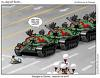 If the roiling tide of socialist-secularist incursion proves the irrepressible globalist force of our worst fears, it stands to reason that those already conditioned to the horrors of collectivist repression have a shorter route to full adjustment than the rest of us. After all, those whose ideological palettes have once tasted and indeed, feasted, on the sweet milk and tender victuals of liberty, are afflicted with full knowledge of what stands to be lost if our cause does not succeed in forestalling the advancement of global tyranny and enslavement. We who have breathed free air and basked in the warming knowledge that only free men can truly feel will find it no easy task to bear master’s lash and the raw agony of spirit and soul encased in debtor’s chains.
Count on it being a rough psychological ride.
Don’t be surprised if some of us throw ourselves off.
Adjustment to collective misery as a replacement for prosperity and liberty is no crash course. It takes practice and expertise, and those born to it are bound to be much more accomplished at playing possum than the unbroken colts of the American West who still cling to the notion that the individual is God’s greatest accomplishment and most unblemished and promising canvass.
Patrick Henry would have understood. I’ve witnessed it first hand.
In 1995, I had the chance to live and study in mainland China. Besides learning to love the often meager and inventive culinary innovations of a people who subsist on varying permutations of fish and rice, and rice and fish, each day inside the world’s largest and most powerful example of collective domination was an object lesson in sociopolitics.
People in China smile. 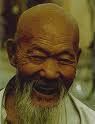
Always.
Whether the indentured old man who pushed the water cart along the cramped and slime coated corridor of the train from Beijing to Guangzhou, or the wrinkled washer woman who carted her duffel of soiled linen, shoeless, back and forth beneath my hostel window morning and night, on the faces of even the poorest and most destitute soul, ‘the smile’ was always there, and it never ceased to make me think. While Tiger Woods and the Dali Llama might tell you that Buddhism gets the credit for joy in such dire circumstances, my own explanation is simpler and less, well….Buddhist. I chalk it up to ignorance and resignation. You see, the expectation of misery and it’s comprehension didn’t reside in the simple act of pushing a drink cart while wearing the tattered insignia of government sanction hung over the emaciated frame of government fostered malnutrition. The old man didn’t know any better. But I did. The perception of misery lay mostly inside of me and my comparative awareness about the contrast between glorified slavery in China and the promising future of self-determination and reward that were only a plane ride and a decent shower away. For me, the ringside seat to Orwellian group think was a temporary experiment. For 1.5 billion people, it is an inescapable nightmare, and a nightmare many don’t fully comprehend, because it’s all they will ever know. After a lifetime of oppression and hapless, dead-end resignation, the old man didn’t know any better about what human life could or should be, if only it’s lived in a place where the individual has a chance to live and be and feel and do. How could he possibly have known? As admirable as his smiling countenance was amid pitiful daily circumstances any American would have considered deplorable, it was a smile of contentment based in ignorance. It was the smile of the damned. It is a smile I couldn’t have faked, on a bet, even if it meant my life.
And it very well may have.
On the damp and sticky streets of Xian, the capitol of Shaanxi province, our student travel entourage arrived curbside for lunch at a Mandarin restaurant. As we stepped off the bus, our eyes were instantly drawn to the pitiful spectacle and plaintiff voice of a man begging for alms. None of us was prepared for what we were about to see. Perched and rocking on a small wooden dolly with rusting rollers, the wailing man appeared to be the worst example of Thalidomide poisoning I have ever seen in person. While clearly middle-aged, his shirtless torso was the size of a small child’s with visibly fragile ribs protruding from a concave chest and attached to a twisted spine. His arms and legs were horribly stunted and malformed, more resemblant of small amphibious flippers than of human limbs. But it was his skull that caused audible inhalations of grief and sudden tears among our group. Either by surgical intrusion, or further chemical defect, it appeared that the full extent of the right hemisphere of his brain was missing, or had never formed. While much larger than the rest of his body, and normally rounded on one side, the top of his skull featured a jagged L-shaped depression that ran the full length of his head, sinking to just above his eyebrow on the right side of his face. Evidenced by both an obvious lack of cranial space and the uncomprehending stare on his contorted face, it was instantly apparent, the poor man had only half a normal brain. As the 20 members of our student group stood slack-jawed in stunned silence, transfixed by the tragic vision before us, what happened next is an image so troubling, that has never retreated far from my mind, ever since. A staccato communication by our government escort on a two-way radio was met moments later by a rush of fatigued men, who seemed to appear out of nowhere, boots and helmets and government greens on full display. Brandishing black truncheons and jabbering loudly at the despairing beggar, the group of combat police began beating the man about his head and shoulders, driving and kicking him away from the growing audience of foreign eyes. In moments, the beggar was out of sight behind the restaurant and down the alley, where only the sounds of the continuing onslaught provided evidence of his suffering. Our tour guide rushed desperately to pull us inside the restaurant and to convince us that what we had just seen was a necessary action. As we protested the brutality and inhumane treatment of the helpless urchin, my conscience cried out at my lack of action outside. It had happened so fast, and the outcome seemed impossibly inevitable. Despite our horror, and the obvious injustice of the moment, none of us had moved to help the man.
We had done nothing, and had lived to regret it, cursed eternally to remember the shocking difference between government by divine providence, and the application of mechanized utopian rage.
Author and philosopher, H.G. Wells, summed up that agony with his infamous summation of the difficult proposition facing the sons of liberty in confronting the realities of the advancing horde and it’s merciless liquidation of individual rights:
“Countless people will hate the New World Order,” Wells wrote. “And will die protesting against it.”
The truth of Wells’ observation is inescapably vivid. While future generations of Matrix-dwelling, post-American primates will find their daily lot no more troubling than a government issued water cart, those of us with memories and historical perspective will not fare as easily in accepting the realities of collectivism at the tip of a billy club, or the barrel of a gun. That lack of adjustment will prove disconcerting and inconvenient to our overlords in ways that will likely jeopardize our long-term usefulness to the company line. It’s a safe bet that humming the Star Spangled Banner will be no better way to avoid drawing attention from Big Brother’s assimilation squadrons, than to prove a pitiful embarrassment by begging change on a city sidewalk.
Pass the Soma, Aldous Huxley.
Truth be told, for many of us, the choice of physical death as a blood sacrifice for the cause of freedom will prove easy to make, if it comes to that. For the inescapable reality is that there will be death in either decision, only of differing variety. Avoidance of conflict and acquiescence to the whim of the dictator offers death of heart and soul that physical death merely completes in quicker fashion. If faced with either eventuality, there will be a great many in the transitory generation between freedom and totalitarianism who would prefer the dignified rush of freedom’s last gasp to the test tube silence of surrendered resignation. It’s part of the American ideological genome that will take a long time to fade away.
Maybe, just maybe, there’s still time to use that persistent, inner voice to motivate decisive action and message in the opposition to the grinding machine that the enemies of individualism and national sovereignty have fashioned as their dispensary of meticulous brutality. We can only hope.
After all, there’s a reason, “Give me liberty, or give me death,” was such a catchy slogan.
Things always catch on when they’re deeply felt, meant, and lived out by the people who speak them.
Divine truths are funny that way.

16 comments for “Chinese Democracy, Compassionate Socialism and Other Myths”