

If you are paying taxes, are you willing to have your money used to support someone’s drug habit?
The answer for many is a resounding “No”. Yet there are others who believe that using drug testing as a prerequisite for receiving welfare is a major infringement on the “rights” of the potential recipient. Those with the latter view are delighted with a graphic that indicates drug testing in Florida has been a spectacular failure in term of its cost to benefit. If Facebook contained a “like so much I am turning summersaults because I am right” button rather than a simply “like” button, these folks would be wearing out that button in their haste to share the good news.
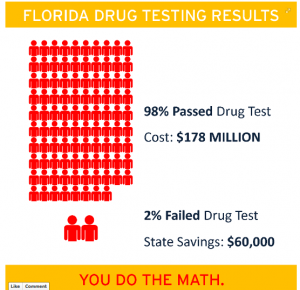
Thanks to The Pragmatic Progressive Page for this image.http://www.huffingtonpost.com/2011/09/27/drug-testing-welfare-_n_983235.html
Did Florida really spend $178 million to save $60,000, thereby proving that drug testing of potential welfare recipients is not cost effective? From the information presented, 2% of the applicants failed the drug test. Each of the numbers given in the graphic appears to be either at least somewhat in error or subject to challenge, but for current purposes we will assume them to be correct. We will first challenge the interpretation and the logic. The numbers, which nevertheless have some merit, will be challenged in a subsequent article.
The Florida drug tests were mandated by state law and were well publicized. What the results actually show is that, EVEN KNOWING IN ADVANCE THAT THEY WILL BE TESTED, 2% of those tested failed the test. So 2% of the drug users guessed incorrectly in terms of how long their drug usage could still be detected in their urine. Insofar as a urine test is concerned, virtually every drug has been flushed from the system in no more than 90 days. A ninety day clearing time was apparently too long to wait for 2% of those anxious to receive welfare. To truly determine the drug-related abuse of potential welfare recipients, the test of choice would be on hair samples; hair samples would contain drug residues from drug use for at least during the preceding year. If we were to assume that drug use amongst potential welfare recipients approximated that of the admitted use by the general population, the number of persons eliminated from eligibility by hair samples would have been closer to 14%. My suspicion is that the Florida urine tests have proven to be a poor screening tool rather than that they have proven welfare applicants to be remarkably lower in their drug consumption than the general public.
Although I personally favor drug testing and join those who have no desire to pay for someone’s drug habit, the Florida results can be useful for several reasons. In terms of economic efficiency, they may demonstrate that the Florida model may not be the best model. Hair analysis would dramatically improve the screening results; if detecting drug usage is the objective, why not require hair samples and actually determine that usage? To the extent that testing is expensive, is it really too much to ask that the $30.00 cost of the test (hair samples could be slightly more) be borne by the welfare recipient? That would prevent screening costs from being an additional burden to the state. Drug testing of potential welfare recipients is being vigorously challenged. http://pathologyblawg.com/pathology-news/appellate-court-upholds-injunction-urine-drug-tests-florida-welfare-recipients/ . Perhaps the courts will remember that drug testing is not considered to be a violation of individual rights for those obtaining and keeping employment.
Testing controversy aside, are we being presented with a false choice if the only option is to simply deny service? While remaining unwilling to support someone’s drug habit, shouldn’t we remain willing to help those who can be helped? Why couldn’t/shouldn’t these tests actually be used to identify the people who could benefit from rehabilitation? Rather than simply deny any and all welfare, why not consider conditional welfare with continued eligibility based upon close monitoring and subsequent drug rehabilitation? Early intervention could be very cost effective; if it were to minimize future costs to society, especially to the children who suffer the most from parents on drugs, testing could ultimately benefit people on both sides of the mandatory testing issue as well as those being tested. This new cost to benefit ratio would be quite hard to calculate. We will disregard any such potential benefits when we challenge the math on the above graphic in a subsequent article.
***Gary A. Howie MSc, PhD*** is a business owner/rancher and a Life & Liberty News contributor


5 comments for “Drug Testing Welfare Recipients—Cost Effective or a Waste of Money?”