 by Duke Doering
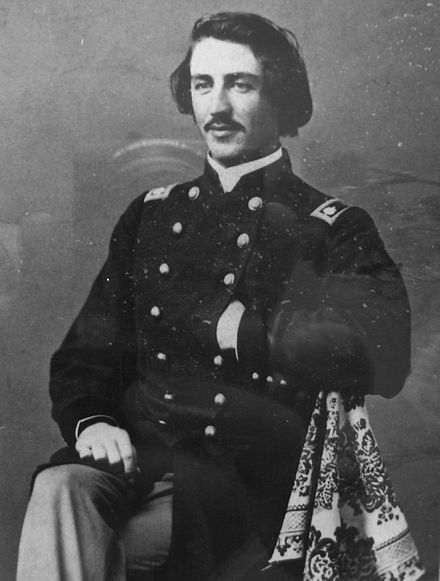
Gen. Edwin S. McCook died of wounds on September 11, 1873, after being shot in Yankton, Dakota Territory. General McCook was Secretary of the Dakota Territory in 1873 and lived in Yankton, the capital. The territorial capital was Yankton from 1861 until 1883, when it was moved to Bismarck.
Edwin was one of a famous family of Civil War officers, the “Fighting McCooks”. He was born in Carrollton, Ohio, the son of Daniel McCook. Edwin was educated at the United States Naval Academy at Annapolis, Maryland, and was a member of the Naval Lodge #69 of the Freemasons in New York City. When the Civil War erupted, McCook recruited a company and joined the 31st Illinois Infantry, serving under his friend, Col. John A. Logan. He saw action in the battles of Fort Henry and Fort Donelson, where he was severely wounded. McCook was later assigned to command Logan’s brigade when the latter assumed division command.
By the Vicksburg Campaign, McCook had again been promoted to replace Logan as division commander, leading it during the Siege of Vicksburg under Ulysses S. Grant. In 1864, he served with distinction in the Chattanooga and Atlanta campaigns and in the March to the Sea under William T. Sherman. He was brevetted both brigadier and major general for his services in these campaigns. He was severely wounded three separate times, but survived the war.
Yankton, the capital of Dakota Territory, was in the summer of 1873 divided into factions and the rivalry was keen, matters reached a crisis when a train station for the Dakota Southern Railroad, planned for the west end of Yankton was erected in the east end. As a result of this a mass meeting was called on September 10, 1873. Peter Wintermate, a young banker, was a partisan of the west end faction, and Gen. McCook was an east ender.
Secretary McCook was not present when the mass meeting began, but Wintermate took part in the organization, then went out to a saloon to buy a cigar. He found he had no change and asked McCook, who stood at the bar, for a small loan. McCook refused, and the banker, who was a small man, shook his fist in the General’s face. McCook threw the smaller man down and dragged him around the barroom.
Wintermate returned to the meeting, where he arose and said that McCook had just “wiped the floor with him, and he would shoot him on sight.” Presently McCook entered and Wintermate advanced and started firing. McCook rushed him back, knocking over the stove, and after four shots had been fired, wrenched the pistol from Wintermate’s hands and rushed him to a window to throw him out, when he fell exhausted. When the physicians pronounced his wounds fatal Edwin said; “The McCooks are not afraid to die.” A good thing because he died the next day, September 11, 1873.
Edwin McCook is buried, with several other members of the famed family, in Spring Grove Cemetery in Cincinnati. His grave is located in Section 10, Lot 1. McCook County, South Dakota, with the county seat of Salem, was named after Edwin S. McCook.
According to the Ohio Times Reporter, “When Wintermute stood trial for killing McCook, his defense team included Leonard Swett of Chicago, a famed defense attorney who was a good friend of Abraham Lincoln. The key point of contention in the case was whether Wintermute had fired first, or whether someone else in the crowd had fired, causing Wintermute to feel threatened. The banker was found guilty of manslaughter and sentenced to 10 years in prison.” An appeal was filed with the territorial supreme court, based upon tainted testimonial evidence, and a new trial was ordered. For two years Wintermute sat in prison but was acquitted after the second trial.
The South Dakota Historical Society stated, “Wintermute died less than a year and a half later. Two days after his acquittal, he fled the territory with his Family and returned to New York, the state of his birth. His finances exhausted and his health ruined, he died of tuberculosis at his father’s home in Horse’s Head. New York, on 27 January 1877.”
CW3 Shane Toupal, a native of Yankton, added to the McCook story: “I read of this fascinating case in the book, Outlaw Dakota: The Murderous Times and Criminal Trials of Frontier Judge Peter C. Shannon. Yankton was mocked in the media as far away as Chicago and Minneapolis for being home to the murder of such a hero. The Broadway verses Capital faction railroad battle at the root of is also intriguing. Capital street in Yankton is now a quiet, mostly residential street with the scene of the murder (and Jack McCall trial) still standing in the three blocks of business district. Broadway is US Highway 81 and is mainly a business district 39 blocks long. Not only did Broadway avenue develop better, the railroad to Springfield proposed by Governor Burbank and supported by Secretary Cook and the Capital Street gang, didn’t come to fruition”.