

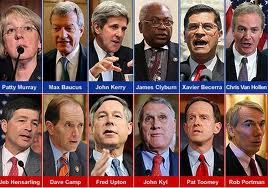
Surprise, surprise-so the super committee failed to recommend at least $1.2 trillion in deficit reduction. What now?
From early in the year, it was generally accepted that the divided Congress would be unable to agree on a budget through regular procedures. Republican Congressional leadership (aka RINO’s) chose to capitulate to Obama’s doomsayers who successfully employed hyperbole about a potential government “default.” Hence, the birth of the Budget Control Act of 2011 (BCA).
The BCA both imposed a set of discretionary spending caps to limit annually appropriated spending and established the super committee to recommend policies that would reduce the deficit by at least an additional $1.2 trillion through 2021. In return, the BCA included debt limit increases in three installments: $400 billion, $500 billion, and then $1.2 trillion. Great deal, huh?
The debt limit hikes were ostensibly contingent on deficit reduction and a vote on a balanced budget amendment to the Constitution. But in fact, under the language of the BCA legislation, they could be blocked only if Congress passed a joint resolution of disapproval. If passed, such a resolution would be subject to a presidential veto, requiring the usual two-thirds vote of both houses to override. Thus these debt ceiling increases up to $2.1 trillion were all but assured from the beginning.
The first two increases totaling $900 billion have already occurred, and the debt limit now stands at an astounding $15.124 trillion. It is up from the $14.29 trillion limit set in early 2010 and follows a history of frequent and growing debt limit increases.
The third increase of $1.2 trillion—projected to occur early in 2012 when the debt begins to again encroach upon the limit—would raise the debt limit to an unprecedented $16.324 trillion, or over 100 percent of GDP.
Thus, the debt limit will climb ever higher, accommodating the unbridled spending of the President and Congress.
Policies that promote reckless spending—forcing the government to borrow about 40 cents of every dollar it spends, while pushing total debt past 100 percent of gross domestic product (GDP)—are flat-out irresponsible.
Equally disappointing, both the existing spending caps and the automatic enforcement in the BCA are less than advertised. The caps contain flaws that may make them all but meaningless. The “sequester” mechanism that would impose spending cuts will not be triggered until January 2013, giving Congress plenty of time to rewrite or abandon it.
The overspending problem is still here. Congress has accomplished nothing but a worsening of an already alarming situation. It should do this without succumbing to pressure to hike taxes on Americans and further weigh down an already struggling economy. Remember, the problem is still Washington’s spending.
Congress should demonstrate that it is serious about tackling the problems of rising spending, debt, and deficits. That means reforms to Medicare, Medicaid, and Social Security; transforming the maddeningly complicated tax system; and reducing the size and scope of government.
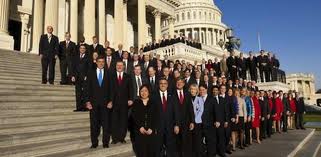
But they will not, because the House Republican leadership is made up of RINOs, liberal, spineless enablers of the progressive liberal left.
Even the 2010 elected “conservatives” offer excuses for their failure to vote by the principles they were elected to uphold. They say things like: “At the end of the day, we have to govern,” as they are seduced by the clamor to “compromise.” (pronounced surrender) and perpetuate the big government socialist agenda of a wonderfully effective president who plays them like a cheap guitar. All the while, they are outmaneuvered and outsmarted by a former community organizer with a wide anti-American stripe.
Every incumbent must go so that those not up for re-election will walk in abject fear of the people they serve.
 ***Ed Randazzo, is a nationally syndicated author. He has been a conservative activist and consultant for over 30 years and is currently the Chief News Editor of Life and Liberty Media***

4 comments for “Super Committee Failure: What Now?”